
Untold Stories, Buried Sorrow.
Stories. When you think of stories, do you think of stories you know or stories you don’t know? I’d bet mostly we think of told stories, those we know. But what about the stories we don’t know and wished we knew?
I have spoken to over 200 groups so far about the history in The Kindness of Color. I’m always amazed how many Japanese Americans in these audiences tell me they don’t know much about their history because their families would not speak of it. Most of the Sansei, Yonsei, Gosei (3rd, 4th, and 5th generation) descendents tell me their families don’t speak of the years before, during, and immediately after the WWII years or the impact on the family. I didn’t feel like I knew a lot, but I’m finding out that I know much more than many others do about family history. But really only on my father’s side; much of my mother’s family history is a mystery.
I get it. It is totally understandable given the significant loss of their dignity, trauma and losses the Japanese American families endured that they would not want to talk about it. I realized that though it wasn’t frequently spoken of at my home either, I did end up knowing more about my father’s family history than many Japanese Americans of my age.
But I still have more unanswered questions; some questions I asked and I didn’t get answers to; and other questions I never thought to ask.
When I asked my mother Yone about her parents, Makisaburo and Moto Sasaki, all I would get is, “I don’t remember, that was a long time ago.” When I asked her sister, my aunt Rakumi, about her mother, I got a little bit more. She said that my maternal grandmother, Moto, came to America (in 1917 in her late 20s) from Japan because she wanted to be a Christian, having heard about faith in Jesus from missionaries in Japan.
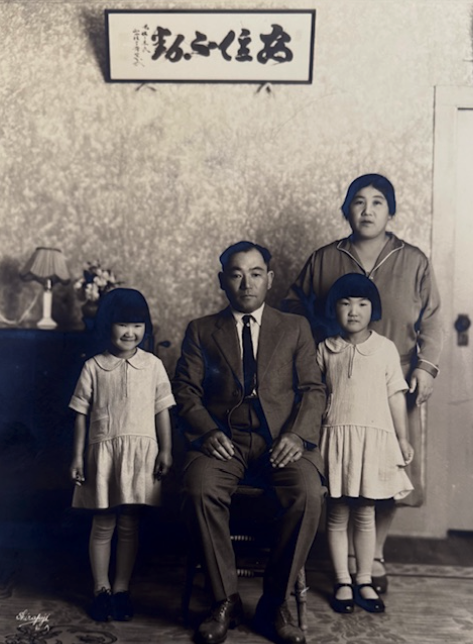
The Sasaki Family, circa 1930s.
Rakumi, Father Makisaburo, Yone, and Mother Moto.
To convert to Christianity in Japan would be very difficult and she might have been severely ostracized to have this faith. It had only been a generation before hers that experienced persecution of Christians by torture and death for 260 years (1608-1868). In America, Moto made sure her daughters went to the First Baptist Church of Garden Grove, a church who welcomed Japanese immigrant families and that is where my mom and aunt went to church from childhood til their deaths.
I knew my maternal grandfather, Makisaburo, was a farmer and I have some limited documentation on that. From records and documents, I found more clues to his life. He came to California in 1903 when he was 20 years old. It seems that he met Moto when she was hired as a household cook on his farm, and later he would marry her. He was leasing land to farm on, and somehow despite the Alien Land Laws that restricted Japanese immigrants from owning land, there is a document that indicates a mortgage payment for 330 acres of farm land. All in all, he may have farmed several hundred acres of chili peppers, sugar beets and string beans.
So many questions here: How did he become so successful to farm that much acreage? Did he really “own” land as an immigrant - what is the story behind what appears to be a mortgage document? More things to research…
Putting together pieces of the story, Moto was an experienced cook who likely cooked for the farm workers too. My mom was a good cook - perhaps she learned this skill from Moto.
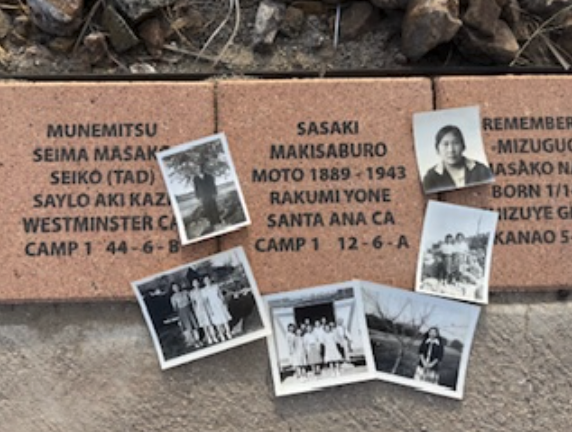
The WWII incarceration years were especially hard on the Sasaki family. Moto died after only 8 months in the camp. When I found my aunt Rakumi’s diary after she died, I found entries of daily visits to the camp “hospital” which likely was more of a clinic with beds. My aunt told me she thought her mother died of a stomach disease (cancer?) but her death certificate said she died of congestive heart failure. Likely, both could be true - an incurable disease that led to heart failure is possible. The camp “hospital” was surely not well equipped to deal with significant diseases and Moto would be one of 1,862 people who died in the Poston incarceration camp. She died in January 1943 at age 52.
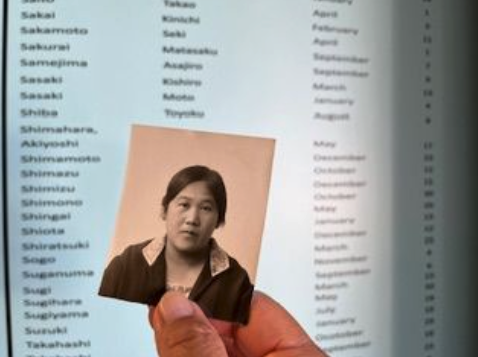
Moto and the list of names of those who died and never left the Poston camp.
Questions: What did she really die of? Could she have survived if treated in a big city/Los Angeles hospital? Could there have been other options for better care? What was my grandmother’s personality like? What did she like to do? What did her voice sound like? What was her favorite thing to cook and to eat?
Her suffering was likely accentuated by the harsh conditions of living in a tar-paper barrack with the intense summer desert heat, the never ending dust, the severely cold winter, and limited health care expertise.
For a man who had likely farmed hundreds of acres, and had now been in America for 39 years, the unjust incarceration had to be a major blow, not just economically but to his emotions and outlook on life. Assigned a 20 by 25 foot section of a 100 foot long, tar-papered barrack for the family’s living space, another assault on his dignity was being assigned a camp caretaker for $16 per month, hardly a fraction of his farm income.
I also don’t know what happened to my grandfather’s farm. I know that he didn’t have much to come back to, probably just a house and a small plot of land; it's possible he came back severely depressed after the death of his wife and the losses he incurred after working for decades. Likely, he sold much of what he did have at a loss before the camp years, unable to sustain the farm during WWII or pay the property taxes without the farm income. He was already 60 years old when he was incarcerated into the Poston camp, and would die at age 69 in 1951.
In contrast, to my father’s family, where my grandfather was middle age at 43 going into the camp, with my dad as his oldest son to help him after WWII, Makisaburo lost much and was at an age that starting over was just too much for him. It would be too much for anyone in that era.
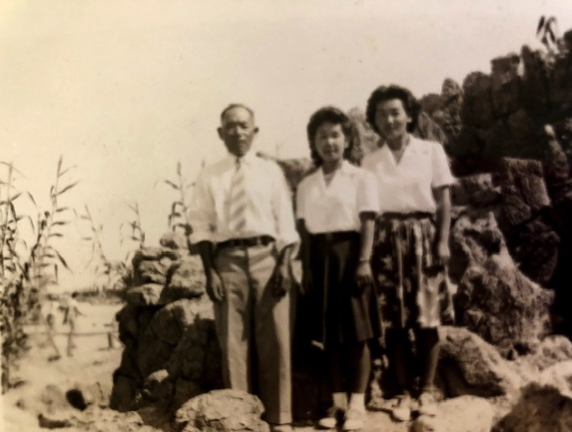
Grandfather Makisaburo, Aunt Rakumi, and Mom Yone,
Poston 1943, after grandmother Moto’s death.
More questions: Why did he come to America? What motivated him? How did he start out farming and how did he get to farm his own property? Who were his friends? What did his voice sound like? He suffered much, how did he continue to persevere?
I think he must have died heart-broken in many ways, though he raised two hard working daughters, I feel the pain and sorrow in the story of his life I do know.
I hope to continue to research this side of my family’s story, but even if I don’t find out much more, I honor my grandparents, Makisaburo and Moto Sasaki, for their hard work, perseverance, and sacrifice for my mom and aunt, and ultimately, for me. Their lives are untold stories I wish I knew. My mom’s and aunt’s grief and sadness in remembering them hid much of their story from me, almost as if burying the stories would bury their sorrow too. But no matter the reason, I am grateful for their lives and their sacrifices as a loving granddaughter who they never knew.
Life is certainly a web of joy and grief intertwined. Holding that tension of knowing our family stories and holding the actual loss, significant trauma, and pain in life is not easy. But I hold hope amidst this web of joy and grief intertwined. I believe every life lived is valuable and worthy of honor. Every story, even the incomplete and untold ones, help me to hold close to those I never knew.
I encourage everyone to ask your older family members a lot of questions now and keep asking if they don’t answer you right away. Little by little, you may gather important puzzle pieces. Trust me, you’ll be glad for every piece, every story you are told.

In the Press

Follow us on Facebook, Instagram & LinkedIn as we cultivate kindness together