
Defining Courage Thru Japanese American Lives
Defining Courage Thru Japanese American Lives
In October, I invited Tommy Dyo to join me and share his family story at JANM’s Democracy Center in our “Camp Leftovers” story telling. Online, I noticed that Tommy was social media friends with some of my out-of-state friends on social media - what a small world! But when I asked them, they said they actually had never met in person! They all had interest in Japanese American history, so that led me to call Tommy Dyo and see if he would give us his tour of Little Tokyo. With a family history in downtown LA before and after WWII, Tommy has an unique perspective and is a great tour guide for Japanese American history and Little Tokyo.
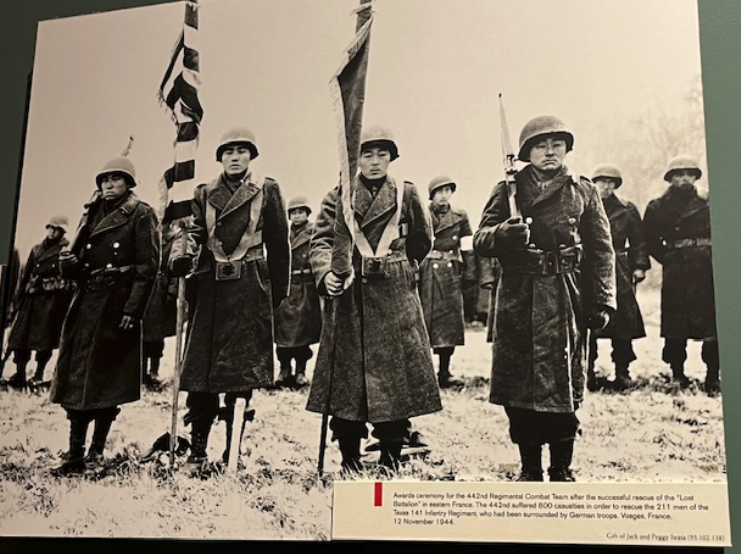
First stop was the Go For Broke National Education Center, housed in a former Buddhist temple. It was founded to preserve the legacy of Japanese American WWII veterans through the Go For Broke Monument and the Defining Courage exhibit.
“Go For Broke” is the rally call of the 442nd Regimental Combat Team, a WWII Army unit composed of Japanese Americans from Hawaii and the West Coast of the US. For the Nisei soldiers, this expressed their determination to risk everything, put it all on the line to win the war in Europe as well as the war against incarceration and injustice at home. (It’s said that this slang was birthed among Hawaiian high-rolling gamblers for risking it all for a big win.)
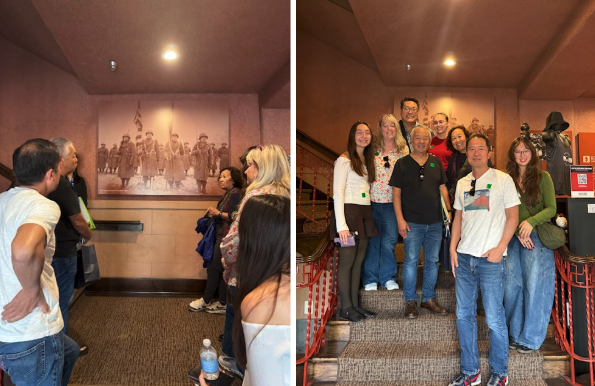
The main exhibit, “Defining Courage,” tells the story of the Nisei men and women who served in WWII. While much of the focus is on the 442nd and the 100th Infantry Battalion, the MIS (Military Intelligence Service) used their knowledge of the Japanese language to aid the military efforts against Japan.
The courageous Japanese Americans from the mainland US served in the US military, while their families were unjustly incarcerated by the same President who led the US military into WWII. Think about that. This is what “Defining Courage” is all about. Or perhaps it should be called redefining courage. Of course, many families did not want them to go, and I’ve heard stories about how the decision to serve became a divisive issue within Japanese American families and the community.
But, serve they did. The 442nd risked it all and still have the distinction of being the most decorated unit of its size and length of service in US military history. By April 1943, a total of 14,000 Nisei men served in the 442nd, earning more than 18,000 awards in less than two years. This included over 4,000 Purple Hearts, 4,000 Bronze Stars, and 560 Silvers Stars, 21 Medals of Honor and 7 Presidential Unit Citations.
The casualties were severe as Purple Hearts are only given when the courageous soldier’s heroic actions are significant and the soldier is wounded, killed, or dies of wounds received in combat against an enemy of the US.
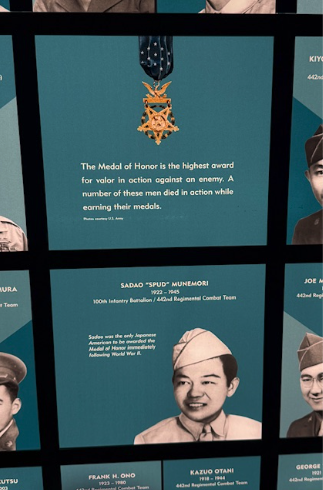
Think about that…Japanese American soldiers received awards for their heroic acts and were injured or died, while fighting an enemy of the US, while their families are incarcerated at home behind barbed wire because the President/US Govt claimed Japanese Americans were suspicious enemies of the US, allied with Japan. I can’t even imagine the grief of the mothers and fathers who while still in the camps, received notice that their son was killed in action, fighting for the country that unjustly incarcerated them, and forced them to leave their lives behind at home.
This is a whole new level of courage, loyalty, and patriotism. The courage of these soldiers was fueled by their determination to prove that Japanese Americans are Americans and they risked everything to prove it. Go for Broke!
Among all challenges the Nisei soldiers had was their physical size. Most were only my size, just a little taller at about 5 feet 4 inches and about 130 lbs (my desired weight!). One display shows the uniform of the average US soldier vs. the average Nisei US soldier. This uniform comparison looked like an adult and child, vs. adults of 2 sizes, so much so that the Nisei soldiers were known as “little iron men.”
A heart-warming feature of the exhibit were the stories of several Americans who stood as allies for the Japanese Americans. Clara Breed was a children’s librarian and an outspoken advocate against FDR’s Executive Order 9066. Clara corresponded with her young library patrons while they were in the camp, sending letters and care packages that resulted in lifelong friendships. Another featured was Herbert Nicholson, a Quaker missionary who traveled to the incarceration camps to encourage the Japanese Americans and to military bases to comfort Japanese American soldiers. He even traveled to Washington DC to advocate for the release of the incarcerees. Stories like this encourage all to do what we can for our neighbors in the midst of severe adversity.
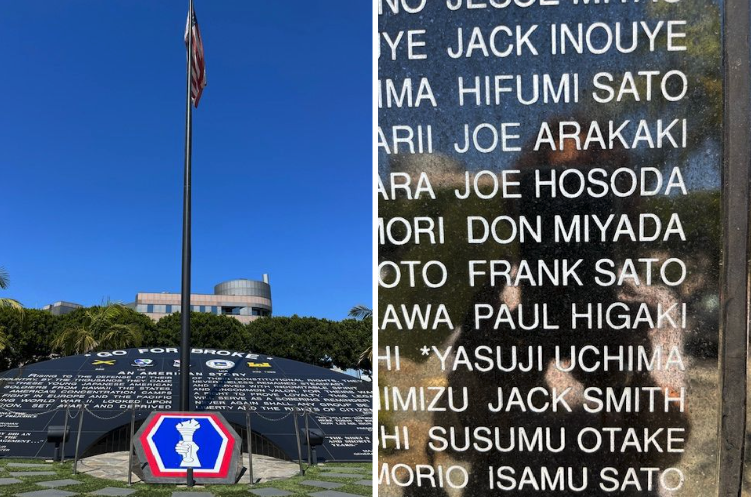
Just down the walking mall, past the Japanese American National Museum and the Geffen Contemporary @ MOCA, the Go For Broke Monument is engraved with more than 16,000 names of men and women who served in the Japanese American units of 442nd, 100th, and MIS. It honors the sacrifices of the WWII members of Japanese ancestry who joined the US military to prove their loyalty and to secure the rights and freedoms of future generations.
I found the name of “Don Miyada” - a So Cal native who lived on a farm once located on land that is now Crystal Cove State Park, Laguna Beach, CA. Don is one of the A Company, 100th Battalion and 442nd soldiers who I had the privilege to meet before he passed away in April 2023. Among the names on the monument, I found several that were not Japanese surnames, like Jack Smith in this photo. Some of these names had Japanese mothers/White fathers or were of non-Japanese ancestry in the segregated Japanese ancestry troops. Every name has its own story, every name worthy of honor and remembrance for their courage and sacrifice for our freedom.
To me, one of the most significant tribute quotes on the monument is from President Harry S. Truman as he welcomed the war-fatigued and injured 100th and 442nd troops back home:
“You fought not only the enemy…you fought prejudice and won.”
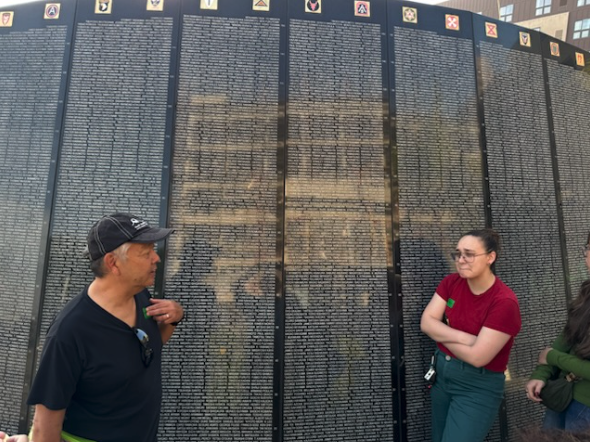
Tommy Dyo explaining the Monument to our tour group.
If you have a family member or friend who served in the 442nd/100th/MIS, you can go to this directory and search for their name and location of their name engraved on the monument:
https://www.goforbroke.org/visit/go-for-broke-monument/find-a-name
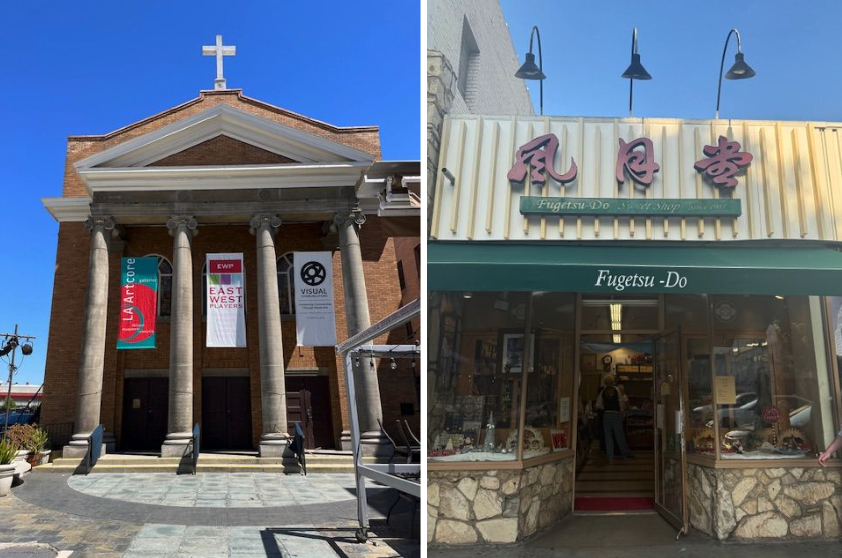
A walk around the block took us to Union Church, formed in 1918 when 3 Japanese language speaking churches united as one. Tommy shared stories of growing up at Union Church and also how during WWII, the basement of this church was used to store family belongings for safe-keeping while their owners lived in the incarceration camps behind barbed wire.
A famous Little Tokyo iconic landmark is Fugetsu-Do, making Japanese mochi and manju since 1903! Known as America’s oldest family-owned Japanese confectionery, nothing much has changed inside or out since I was a kid. We would go to “J-Town” a few times a year. I especially remember getting the pink mochi wrapped in plum leaves for Girls Day, March 3 as a little girl. I can still remember the aroma and that taste! Unforgettable!
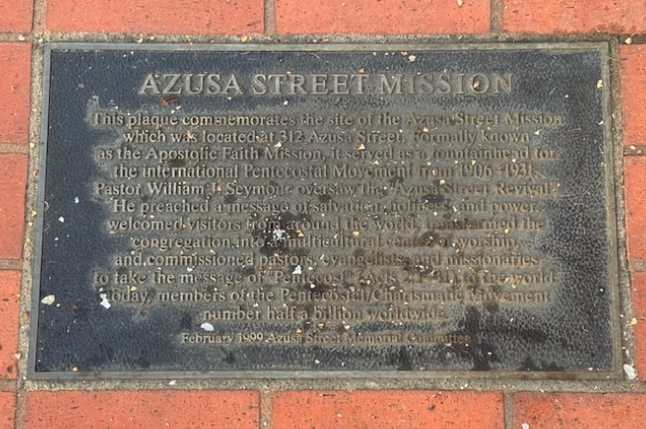
A few blocks away is this small plaque, located in Noguchi Plaza, near the Aratani Theatre, just adjacent to what has to be one of the shortest named streets in LA, Azusa Street. Literally it seems more like a wide alley, and that’s what I always thought it was. I never realized before that this was the site of the historic Azusa Street Mission Revival and the International Pentecostal Movement from 1906-1931. It was led by William Seymour, a son of freed Black American slaves, who came to LA at the invitation of Neely Terry, a black woman who attended a small LA church pastored by another woman, Julia Hutchins. Pastor Seymour led this revival that began April 1906 through 1915. Today this revival is considered to be a major catalyst for the growth of Pentecostalism in the 20th century.
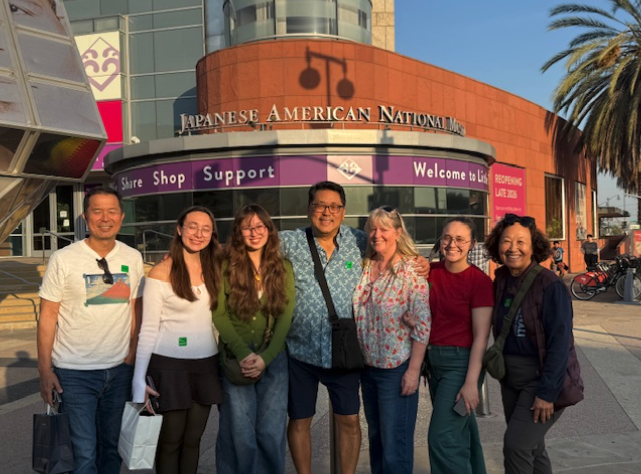
Since the Japanese American National Museum is closed for renovation until Fall 2026, it's the perfect time to see some of these other Little Tokyo sites. We had a great day at the Go For Broke National Education Center and Monument. Check their website for more information to visit: Go For Broke National Education Center
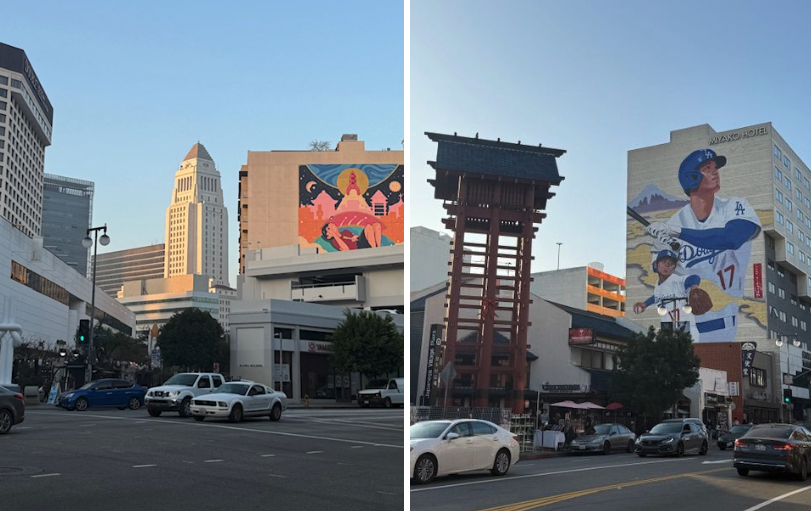
I marvel at what my grandpa and dad would think of today’s Little Tokyo. It’s not the same as it was and sadly, many of our favorite, small Japanese owned shops are no longer. It’s still in the heart of Downtown LA, steps away from City Hall and with the popularity of Shohei Ohtani and the Dodgers, there’s so much more about our Japanese heritage to be proud of!
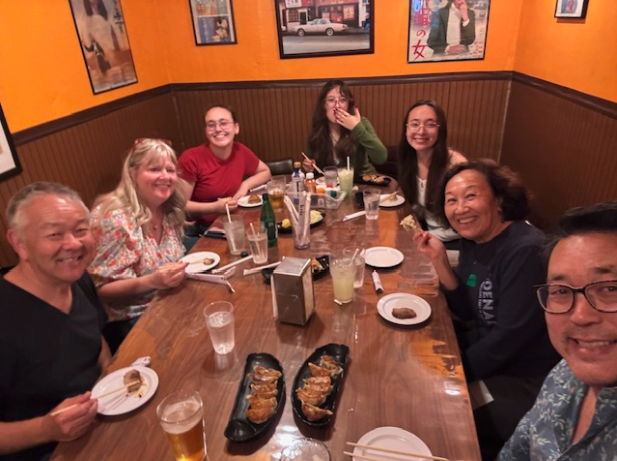
And it wouldn’t be a day in Little Tokyo without Japanese home-style cooking and dinner at Kouraku (314 E. 2nd Street). Tommy not only knows the history, but he also knows the best places to eat! Sukiyaki, Tonkatsu Curry, Gyoza - all delicious!
Thanks Tommy for a great tour and to Scott, Kay,Julie & family for taking the day to explore Japanese American history with me!

In the Press

Follow us on Facebook, Instagram & LinkedIn as we cultivate kindness together