
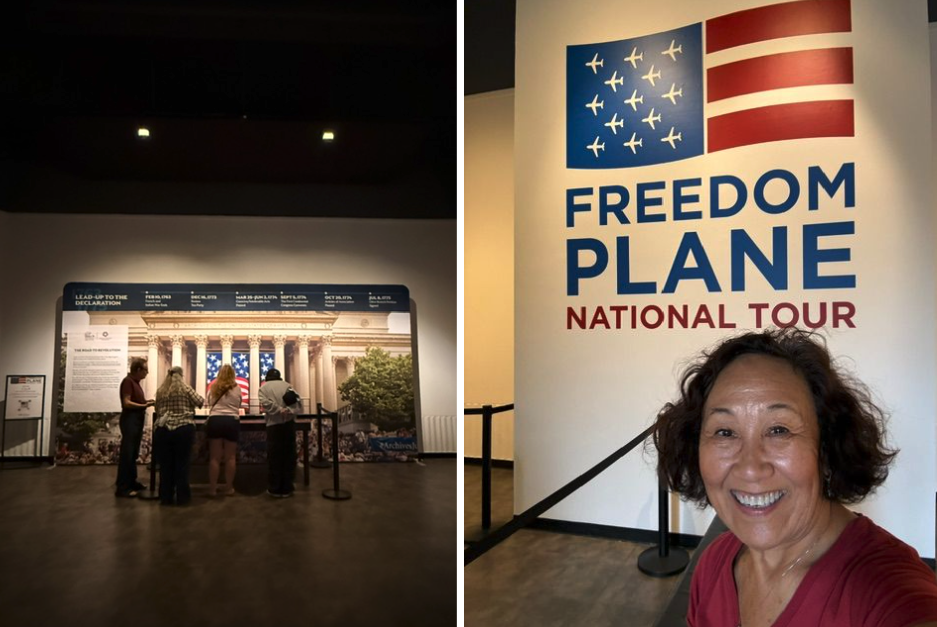
The Struggle for Freedom: Freedom Plane 250
I first read about the Freedom Plane 250 exhibit in an USC Alumni email. Only the 3rd of 7 coast-to-coast stops, a 737 plane was bringing an exhibit of eight founding nation documents to the Fisher Gallery at USC for a brief 2 week showing. (USC was the official Los Angeles stop). I signed up for the free tickets and then began to read more about what I would see.
Just eight documents, some of the most valuable documents of our National Archives, helped forge our nation! From the 1774 Articles of Association to 1789 Bill of RIghts “Draft” Markup, the key mission was to show “the principles enshrined in these documents still guide our lives and continue to shape our country.” (www.freedomplane.org) My take-away was awe and wonder at the documents, the original signatures and a realization that the great American “experiment” for freedom was complex then, and certainly isn’t any simpler 250 years later!
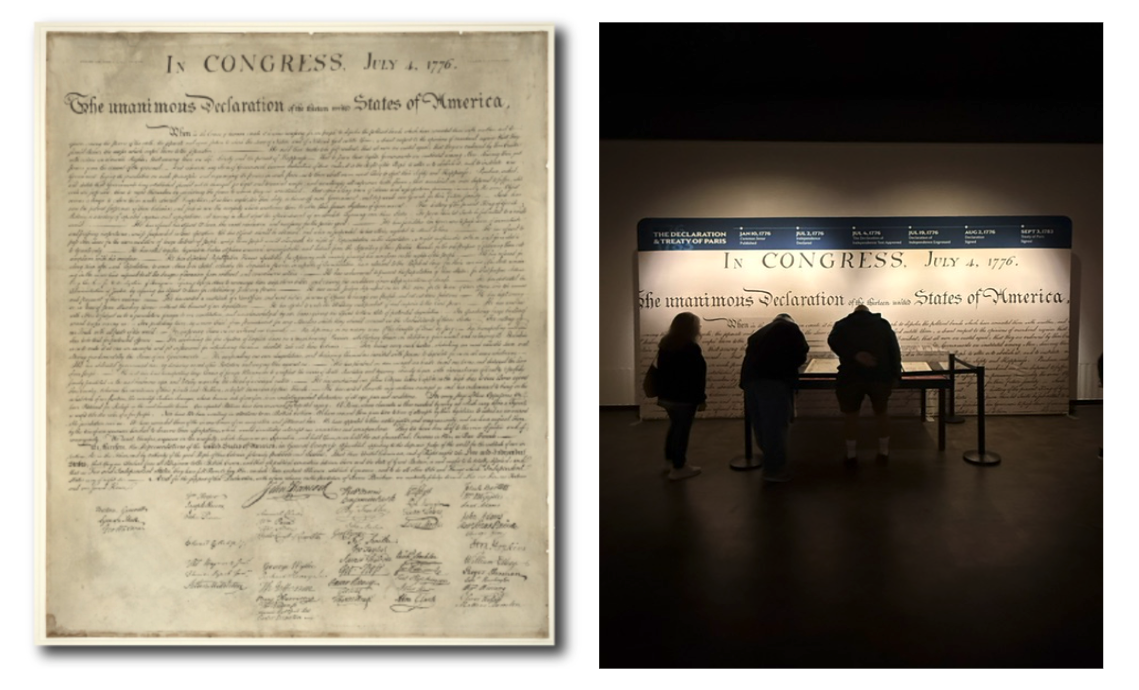
Declaration of Independence 1776
Did you know that the original faded?
Or that the document we see is an engraved reproduction?
Could we be celebrating on the wrong day? July 4th or August 2nd?
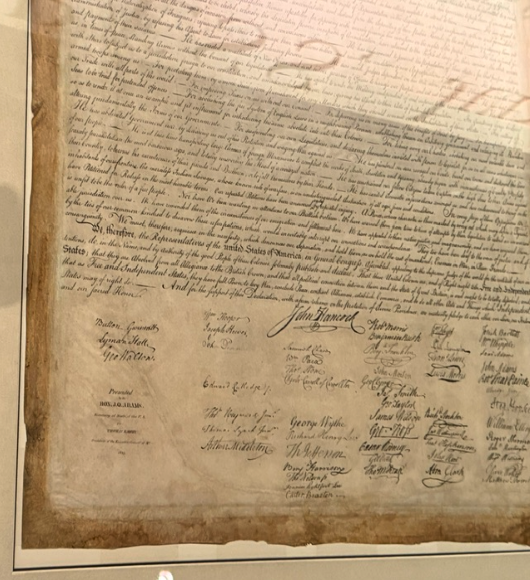
The final text was confirmed on July 4, 1776, but most of the signatories signed it on August 2, 1776. July 4th could have been August 2nd, but it doesn’t have the same “patriotic ring” to it. The original began to fade and so William Stone was commissioned to create engraved reproductions to provide a stable public reference to the original document. In 1823, this document was produced… and includes two “carets” ^ to identify two typos in the original. The errors were kept in to preserve the integrity of the original document. Fortunately, the errors don’t change the meaning or integrity of the document! And seeing John Hancock’s signature is truly a work of art. No wonder, signatures are known as “John Hancocks.”
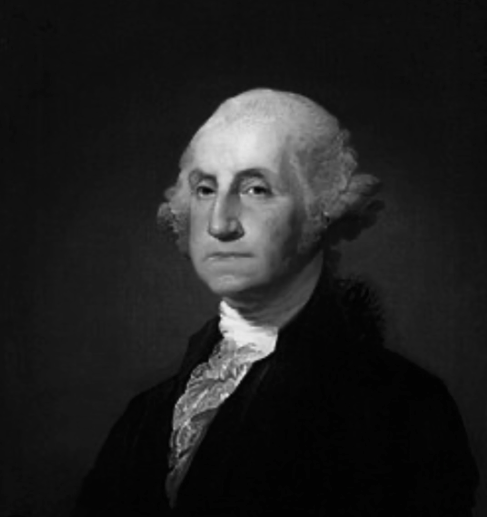
My Japanese immigrant grandpa had a black and white picture of George Washington on the family room wall. Honestly, as a little kid, not knowing any history, it was kind of scary, wondering who is that mad, old white man with long white hair and why is he so mad? Now, I see it was my grandpa’s quiet statement of his immigrant allegiance to the United States, albeit odd through a picture of the first US President. In Japan, it was customary to have a picture of the emperor in your home, so I believe grandpa improvised for his new homeland. Seeing an original signature of George Washington here, made me really consider the determination of these founding freedom pioneers and the risks they took. Maybe somehow, my grandpa understood that as one who leaves his homeland for a better future in the fight for freedom.
Oaths of Allegiance 1778
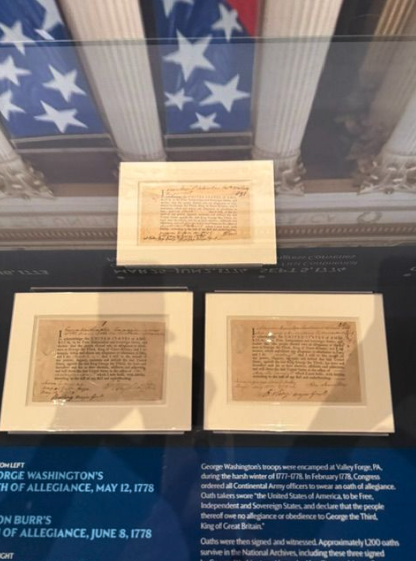
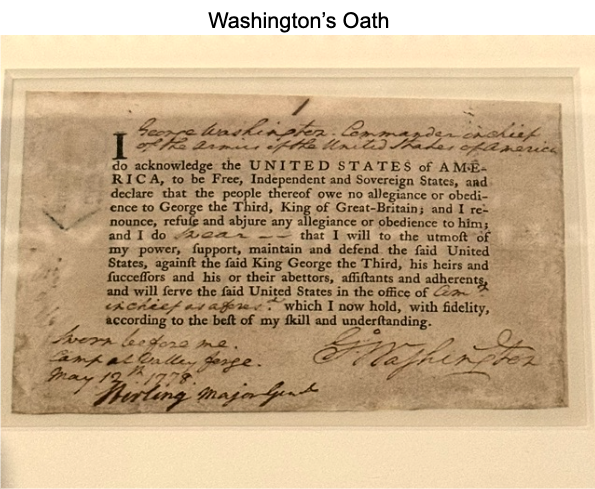
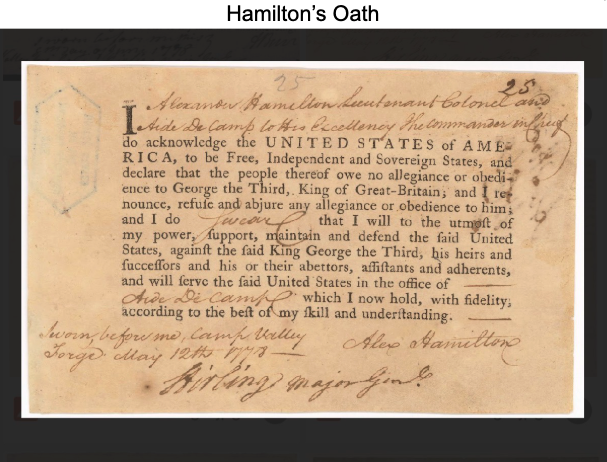
The Continental Congress required officers to sign a formal declaration of loyalty to the fledgling United States, denouncing any allegiance to the British Crown. This was at a time when the outcome of the Revolutionary War was uncertain and the alliances were fragile. It solidified allegiance to the fledgling nation at real personal risk to the signers. They were rejecting any allegiance to King George III and affirming service to a new “nation,” as it was basically still “under construction” with an “ideal of freedom.”
For George Washington, as the Commander In Chief, defeat could have meant execution for treason; Aaron Burr was signing away any chance of allegiance to the British Crown, and for Hamilton, the risk that this ideal would fail to an unknown future. By signing these oaths, they were pledging their allegiance and service to the risky new nation being built.
I’ve got to admit, these original signatures and the risk behind them, really made an impact as I consider the sacrifice and fortitude required in the founding of our country. Not to mention, it reminded me of grandpa’s photo of George on the wall, and his allegiance to his new country that would later unjustly incarcerate him during WWII as a “spy” for a country he left 26 years before.
Treaty of Paris 1783
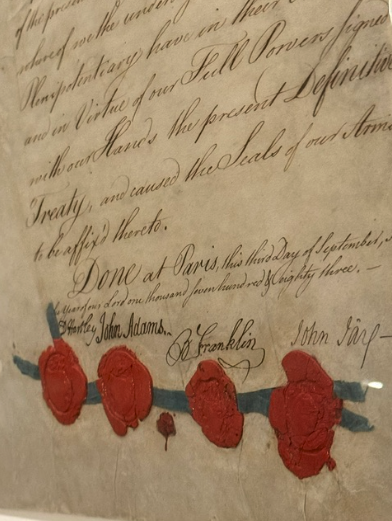
After eight tough years of war, the Treaty of Paris formally ended the Revolutionary War and without it, the United States would not exist under International Law. What they had fought for, was now reality, the United States as an independent nation. Signed on September 3, 1783, this may be just as important as the day the Declaration of Independence was signed. The red wax seals and the clear signatures of John Adams, Ben Franklin, and John Jay for the new United States follow David Hartley, who signed for Great Britain, are indeed striking!
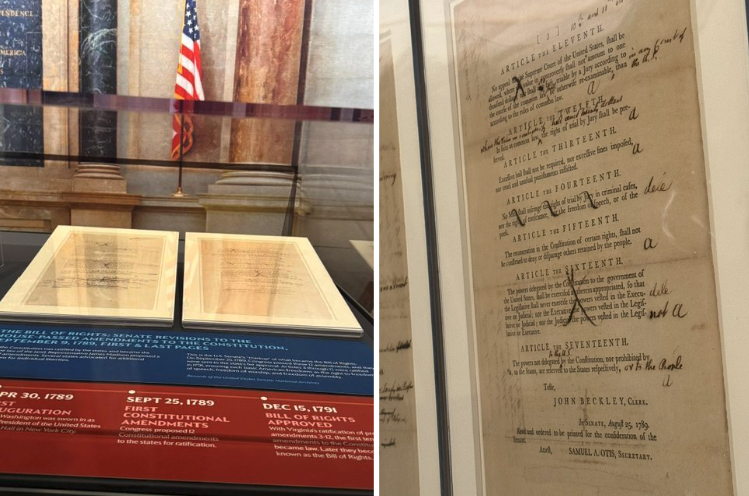
Bill of Rights “Draft” Markup, 1789
Thirteen years after the Declaration of Independence, there is still a struggle to further refine additional protections and individual liberties. This document shows the “work in progress” as drafts tried to capture changes and refinements to get a Bill of Rights completed. It also led to the need for Constitutional Amendments… like the 14th! The Bill of Rights was a key transition “from establishing government authority to defining its limits” in the effort for individual rights. On September 25, 1789, Congress passed 12 amendments, but it wouldn’t be until 1791 for ratification, ensuring such basic American freedoms as the right to freedom of speech, freedom of worship, and freedom of assembly. Again, not a simple process and I can just imagine the hours of debate and compromise to finish it!
__________________________________________
In honor of America 250, it was significant for me to remember and study these key documents. What was hard fought for, continues to be fought for. It was never easy, it was never without sacrifice and risk. As the third generation of courageous Japanese immigrants who believed in, and hoped for, the same ideals that our country’s founding fathers, George Washington, et al. fought for, I am grateful. No it isn’t perfect; it never was. There is still a struggle; and perhaps always will be. But I am grateful for the opportunity to live and strive for this great ideal of freedom, just like my grandpa did. And just maybe my grandpa Seima understood more about the struggle of our US founding fathers than I realized - risk in a new country, accusation of treason, committing to loyalty no matter what. America 250 - May Freedom Reign.
I hope you will want to check out more online at www.freedomplane.org (general information about the documents) and Freedom Plane (more in-depth information about the documents, powered by Clio, a USC Viterbi School of Engineering alumni-founded company).

In the Press
Follow us on Facebook, Instagram & LinkedIn as we cultivate kindness together